Brandon with Nissan of Vacaville shows off the Android Auto features standard in the 2020 NV200. See more at http://www.vacavilleworktrucks.com.

1/02/20
Android Auto in 2020 Nissan NV200 Demonstration - Nissan of Vacaville Fleet
Brandon with Nissan of Vacaville shows off the Android Auto features standard in the 2020 NV200. See more at http://www.vacavilleworktrucks.com.


1/01/20

12/31/19
2020 FORD SUPER DUTY CHASSIS CABS ARE READY TO SERVE WITH BEST-IN-CLASS CAPABILITY

- Super Duty Chassis Cab delivers major performance with an all-new big block 7.3-liter V8 providing 350 horsepower and best-in-class gas torque of 468 ft.-lbs.
- Built for heavy upfit equipment and industry demands, Super Duty Chassis Cab dominates with best-in-class maximum payload of 12,750 pounds
- Third-generation 6.7-liter Power Stroke® diesel V8 hammers out 330 horsepower and 825 ft.-lbs. of torque
The all-new available 7.3-liter V8 is the biggest displacement gas engine in the class and delivers dyno-certified 350 horsepower at 3,900 rpm and best-in-class 468 ft.-lbs. of torque at 3,900 rpm all in a compact, versatile engine designed with commercial durability in mind.
“We don’t operate in a vacuum in Ford commercial trucks, we talk to the customers, dealers and upfitters who know how hard our trucks are worked,” said Nathan Oscarson, commercial truck marketing manager, “That kind of real-world feedback helps us engineer the level of commercial trucks that the industry demands.”
Maximum grunt comes from the available 6.7-liter Power Stroke® V8 offering dyno-certified 330 horsepower at 2,600 rpm and 825 ft.-lbs. of torque at just 1,600 rpm – and improvement of 75 ft.-lbs versus the previous model year. An all-new heavy-duty 10-speed TorqShift® automatic transmission is standard across all engine offerings with available live drive power takeoff. This new 10-bolt power take off provision is capable of a best-in-class maximum 300 ft.-lbs. of stationary torque and comes standard on diesel-equipped models.
“From the 6.2 V8 to the 7.3L V8 to the heavy duty 10-speed, these powertrains are always in the sweet spot of the power band for maximum efficiency and capability in towing and hauling,” said Greg Stout, heavy duty drivetrain manager.
F-series Super Duty Chassis Cab models include business-critical capability like best-in-class maximum payload of 12,750 lbs. which lets customers mount everything from utility bodies to boom cranes. Vocational customization is simplified with available programmable upfitter interface module and drivers appreciate functionality like available flat under seat storage.
Ford Super Duty Chassis Cabs are #1 in commercial truck class 2-5 registrations with 65.6 percent total share of the U.S market*, proving that when the power goes out, when fires must be fought or when bridges need building- it’s dedicated tradesmen in Ford Super Duty Chassis Cabs who come to the rescue.
New Ford Telematics™ and Data Services are available to help commercial customers operate their fleets more efficiently. Ford Telematics enables fleet managers to improve asset utilization, optimize running costs, protect their vehicles and encourage better driver behavior. This advanced technology is enabled in the Super Duty lineup by the inclusion of standard FordPass Connect™ with 4G LTE Wi-Fi for up to 10 devices which keep the truck, drivers and crews connected at all times. Those uptime gains from smart technology continue with Pre-Collision Assist with Automated Emergency Braking and Audible Lane Departure Warning, which can help operators avoid or mitigate collisions.
Super Duty Chassis cab models are available to purchase today. For customers who need additional payload or need to mount heavier upfits but don’t want to move into a larger truck, the all-new Ford F-600 Super Duty chassis cab is just the right fit between F-550 and F-650 and will be available for order later in 2020.
# # #
* Based on IHS Markit January 2019-August 2019 US TIPNet Registrations excluding registrations to individuals
About Ford Motor Company
Ford Motor Company is a global company based in Dearborn, Michigan. The company designs, manufactures, markets and services a full line of Ford cars, trucks, SUVs, electrified vehicles and Lincoln luxury vehicles, provides financial services through Ford Motor Credit Company and is pursuing leadership positions in electrification, autonomous vehicles and mobility solutions. Ford employs approximately 191,000 people worldwide. For more information regarding Ford, its products and Ford Motor Credit Company, please visit corporate.ford.com
12/30/19
All-New Ford 7.3-Liter V8 Set To Drive Best-In-Class Gas Power and Torque For Heavy-Duty Pickups

- All-new 7.3-liter engine in Super Duty pickup cranks out best-in-class gas V8 output of 430 horsepower and best-in-class gas torque of 475 ft.-lb.
- The 7.3-liter engine is paired with the all-new 10-speed heavy-duty TorqShift® transmission on Super Duty pickups and is designed for robust power, long-term durability and ease of service that truck owners demand in both personal and business applications
- Windsor-built engine will be an option on 2020 F-Series Super Duty pickup, standard on F-550, F-600, F-650 and F-750 Medium Duty trucks and E-Series, as well as F-53 and F-59 stripped chassis
DEARBORN, Mich., Ford F-Series, America’s best-selling truck for 42 years, is once again raising the bar for capability with its all-new 7.3-liter V8 gasoline engine. The 7.3-liter engine in Super Duty pickup cranks out best-in-class gas V8 output of 430 horsepower at 5,500 rpm and best-in-class torque of 475 ft.-lb. at 4,000 rpm.
No other competitor provides such a powerful and advanced gasoline engine in such a broad range of offerings – from Class 2 Super Duty pickups through Class 7 commercial trucks.
“The 7.3-liter is designed for maximum durability in the harshest environments given that our customers live and work in these conditions every day,” said Joel Beltramo, Ford manager for gas V8 engines. “This engine has the largest displacement in its class and is designed to provide benefits in key areas like power, durability, ease of maintenance and total operating costs.”
Based on decades of commercial engine experience, the 7.3-liter V8 delivers class-leading performance in a compact package. The 7.3-liter V8 features an overhead valve architecture that generates power low in the rev range to help get heavier loads moving sooner and with greater confidence. It also features a variable-displacement oil pump, extra-large main bearings, forged steel crankshaft for durability, and piston cooling jets to help manage temperatures under heavy load.
The all-new 7.3-liter will be available first in Super Duty F-250 and F-350 pickup models. It joins the 6.2-liter V8 gas engine in Super Duty’s lineup, along with the upgraded third-generation 6.7-liter Power Stroke® diesel V8. Additional power and capability numbers, including Super Duty, towing and payload ratings, as well as power numbers for the upgraded 6.7-liter Power Stroke diesel, will be announced later this year.
A dyno-certified version of the 7.3-liter V8 producing 350 horsepower at 3,900 rpm and 468 lb.-ft. of torque at 3,900 rpm will be standard on F-450 chassis cab, F-550, the new F-600, F-650, and F-750 Medium Duty trucks, and F-53 and F-59 stripped chassis models. The upgraded E-Series will also feature the 7.3-liter V8. An optional calibration intended to help customers reduce their fuel consumption will also be offered; more information will be made available at a later date.
For F-250 through F-600 models the 7.3-liter engine is paired with the all-new Ford-designed and Ford-built 10-speed heavy-duty TorqShift® automatic transmission. All other commercial models retain the TorqShift® heavy-duty 6-speed automatic transmission.
Sprinter Van Build Out - Super Organized
In this video I take a good hard look at the mess that was my 2014 Mercedes Sprinter 2500 Crew Van ( 144" WB). I do a lot of work off site, and its important to keep things organized. I recently bought a bunch of new toolboxes in Milwaukee's new "packout" line, and these were the motivation to redo the inside of the truck. Follow along while I lay out, and build shelving to house all of my tools. This is a HUGE improvement over what I had! Thank you to Pferd abrasives for supporting my shop and my channel.

Make Everything
12/29/19
Tank Choice Affects Alt-Fuel Efficiency

While today’s lower cost of traditional fuels may have shrunk the market for alt-fuel vehicles, they can still make economic sense for light-duty fleets.
One of the often-overlooked aspects to choosing the most efficient alt-fuel system is the choice of fuel tank, according to Chris Hanners, product manager for alternative fuels for Worthington Industries.
Worthington supplies both propane autogas and compressed natural gas (CNG) tanks for light-duty vehicles.
“It has superior fast fill capabilities, 25% more storage capacity because you can fill it 100%, and, thus, better range,” he said. “It also has no filling restrictions.”
One of the added benefits of choosing a Type III tank — no matter the manufacturer — is that the added capacity may mean that a fleet may need fewer tanks to get the same range. This also decreases vehicle weight, increasing fuel efficiency. The cylindrical design of CNG tanks means that light-duty sedan and truck fleets that choose to use CNG may have to accept a loss of cargo capacity. In sedans, the tanks are often mounted in the trunk space, and in light-duty trucks in the bed. Truck fleets can counteract this loss of space by spec'ing a longer bed length, but this could add costs to the vehicle.
If a fleet decides on propane autogas, it will have the option of choosing from a number of shapes, including toroidal, which can fit in the spare tire void in a sedan trunk or under the bed of a light-duty pickup.
“Because the tank can fit in the spare tire space, you still have 100% of your trunk cargo space,” Hanners observed. “On the commercial side, you’ll have 100% of a light-duty truck bed or van cargo space.”
All propane autogas tanks are made of steel, thus add weight to the vehicle. Hanners said that Worthington has solved this issue by using lighter-weight steel, which cuts the weight of the tanks by about 30%.
Source: http://www.greenfleetmagazine.com/channel/natural-gas/article/story/2016/04/tank-choice-affects-alt-fuel-efficiency.aspx
12/28/19
HVAC Transit Service Van Tour
Join me as I give a thorough van tour and walk-through of my new Ford Transit 250, which will be used primarily for HVAC service work. I detail the ways I optimized space, organize and customize the vehicle to work for me and suit my needs. https://www.kit.co/akhvac
GMC Sierra | Puppy | GMC
Spreading holiday cheer this season just became easier. Gift Like a Pro with the GMC Sierra featuring available accessory Kicker Audio.
12/27/19
Enoven Industries - Where Flatbeds are Not Just Flatbeds!

- 100% fabricated and installed in house, all bodies are built for heavy duty use
- Your choice of smooth (10ga, 3/16”) or diamond plate steel or 7/8” and 1-1/8” Apitong hardwood decks.
- Custom builds are our specialty, we can sides to make your flat a rack syle or landscaper body

- Rugby and Omaha Standard Subframe style and truck frame mounted conversion hoists
- Fully hydraulic or electric over hydraulic hoists
- Hoists for bodies 8’ long up to 24’ long
12/26/19
2020 Nissan TITAN PRO-4X Reveal & Overview
Catch a first look at the reveal of the off-road capable 2020 Nissan TITAN PRO-4X with TITAN Ambassadors Maddie Brenneman, Cory Bahr, and Chef David Rose. Learn More about the 2020 Nissan TITAN here: www.nissanusa.com/2020titan?dcp=snx.ttn.FUT.rev.ytb Off-road capable and loaded with tech - meet the stunning new 2020 Nissan TITAN PRO-4X. Featuring TITAN Ambassador @MaddieBrenneman TITAN not yet available for purchase. Expected availability early 2020. Pre-production model shown; see actual production vehicle when available for final details on features. Please see Owner’s Manual for important feature information.
9 Reasons To Keep Your Tow-Behind Air Compressor
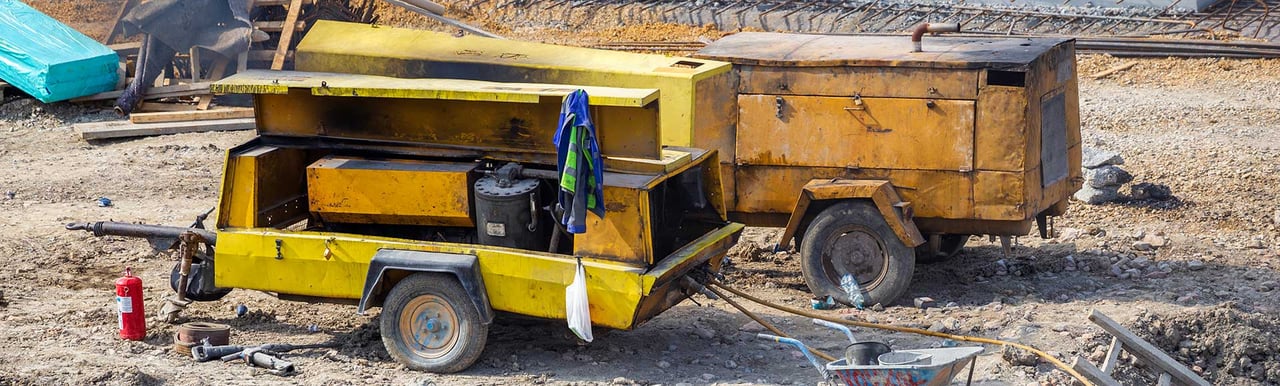
Tow-behind air compressors have been popular in many industries, including construction and utilities, for decades. This equipment made it easy for contractors and operators to ensure they were able to take their air compressor with them to the job site.
Today, owners, operators, and fleet managers have more options for mobile compressed air than just tow-behind air compressors. Manufacturers continue to innovate with a variety of options, from hydraulic, gas, and diesel powered above-deck air compressors, UNDERHOOD™ air compressors, and underdeck PTO-driven air compressor systems. But even with these innovative air compressor solutions, which pack a lot of power into compact packages, many
people still have a problem letting go of their trusty tow-behind air compressors. Here are 9 reasons to keep your tow-behind air compressor:
9. ENJOY THE CHALLENGE OF DRIVING AND PARKING WITH A TRAILER
Your experience towing your bulky air compressor has given you the skills of a precision driver! You’ve successfully merged onto busy freeways, reversed without jack-knifing, and managed to find parking in even the most crowded job sites. You have a sense of pride in the skills you’ve honed over the years of navigating your truck and trailer in all sorts of tricky (and frankly, stressful!) situations.
8. TAKE YOUR TIME TRAVELLING TO JOB SITES
Trailers can hinder your access to job sites, especially mobile service work in remote or off-road areas. If you enjoy taking extra time and care to navigate your way to hard-to-reach job sites, then it’s best to stick with your tow-behind.
7. MONOPOLIZE YOUR HITCH
tow-behind-on-hitchYour truck came with a tow hitch for a reason, so you’re going to use it! Now you can always use your tow hitch for your air compressor. If you need more equipment, then you will have to have another vehicle and driver sent out to bring all the required equipment to the same spot. That means the second truck will have the opportunity to use its hitch too.
If you feel like doing it all yourself, you can make two trips to the job site—one to drop off your air compressor, and one to drop off the rest of your equipment. Driving around is fun!
6. ONLY TRAVEL WITH YOUR AIR COMPRESSOR SOMETIMES
Every service job will present you with the opportunity to guess: will I need my air compressor for this job? You can bet on the odds of whether you’ll need to bring your tow-behind with you to the job site or not. Keep track of how many times you guess right, and how many times you must turn around to go back and collect your trailer.
5. SPEND LOTS OF TIME TAKING EXTRA SAFETY PRECAUTIONS & MEASURES
We hope everyone is passionate about workplace safety, and if you have a tow-behind air compressor, you’ll get to indulge this passion practically every day. Tow-behind air compressors have a lot of parts to check frequently. You’ll need to ensure the hitch, taillights, and tires are all in working condition. If any of these parts are failing, then you’ll get to spend part of your day fixing them, instead of actually getting down to work. If you’re a procrastinator, this is the best!
It also takes vehicles pulling heavy tow-behind air compressors longer to stop. To be able to stop quickly and safely, you’ll have to drive at reduced speeds whenever you’re towing your air compressor. You can learn and observe tow bar regulations and adjust your driving to make up for a larger blind spot.
In addition to all the safety checks you’ll enjoy doing, you’ll also have the opportunity come up with safety measures to ensure thieves don’t steal your tow-behind. It’s much easier to steal a tow-behind than to steal an above-deck air compressor, or a vehicle integrated compressor, like an UNDERHOOD or a transmission-mounted PTO drive air compressor. But since you like a challenge, and you’re passionate about safety and security, you’ll enjoy taking extra precautions to ensure your tow-behind is not stolen. Channel your inner Kevin McCallister in Home Alone and have some fun setting up booby traps every time you need to park your vehicle.
4. LOTS OF ENGINE MAINTENANCE
engine-tow-behind-air-compressorTow-behind air compressors come with their own engine, in addition to the engine that’s part of the service truck or van that’s doing the towing. This means that you’ll have two engines to maintain, and you’ll spend more time and money making sure both engines are in tip-top shape.
Several mobile air compressors use the vehicle’s existing power sources to run, such as gas and diesel vehicle engines, transmissions, or PTOs that run hydraulics, but where’s the fun in only maintaining one engine?
3. SPEND MORE TIME WORKING ON EACH JOB
Tow-behind air compressors take time to position properly and set up on the jobsite. They require a lot more prep work than a vehicle-mounted mobile air compressor. If you enjoy spending additional time each day setting up your equipment before you actually start to work, then a tow-behind is a great option.
2. USE MORE FUEL, INCREASE YOUR TRUCK’S WEIGHT
Tow-behind air compressors are beasts. They’re thirsty monsters when it comes to fuel, when you account for the extra consumption to run the tow-behind, as well as the extra fuel your truck will use to lug a 1,000+ lb air compressor. Your local gas station attendants will love seeing your truck and trailer chugging into the station for another big sale!
Speaking of weight, do you like adding extra weight to your truck? If so, you’re in luck—even though the Atlas Copco XAS 110 is considered to be a smaller sized tow-behind air compressor, producing up to 110 CFM, it still weighs 1,100 lb. It’s much heavier than the UNDERHOOD™ 150 air compressor, which weighs in at only 200 lb.
1. STAY TRADITIONAL WITH YOUR 1980s COMPRESSOR
tow-behind-air-compressorAnd the number one best reason to keep your tow-behind air compressor is that you are a traditionalist! You enjoy the nostalgia of using the tow-behind. All the extra time spent driving around, setting it up, maintaining it, and keeping it safe is time well spent! The challenges driving, maneuvering, and parking build up your character. And of course, you love utilizing your truck hitch to carry around your 1,000+ lb tow-behind.
Do you have second thoughts about keeping your tow-behind air compressor? There’s another option. Vehicle mounted air compressors are the right choice for people who:
- Need mobile air regularly
- Have light to medium duty applications
- Want more space for cargo, tools, and other equipment
- Prefer less weight on their vehicles
- Want to minimize maintenance
- Desire the freedom and convenience of trailer-free driving
Learn more about VMAC Underhood Air Compressors at: https://www.vmacair.com/
12/25/19
Merry Christmas and Happy Holidays!

Wishing You a Peaceful and Joyous Holiday from Commercial Truck Success!
12/24/19
The 2019 Chevrolet Silverado 6500HD Unveiling - Work Truck Show
Ed Peper, U.S. vice president of General Motors Fleet, talks about the new Chevrolet Silverado 6500HD at the Work Truck Show in Indianapolis, bringing Chevrolet back into the medium-duty commercial truck market.
Read more about the three new medium-duty commercial trucks: http://www.worktruckonline.com/news/s...
Apple Carplay in Nissan NV200 Demonstration - Nissan of Vacaville Fleet
Brandon with Nissan of Vacaville shows off the standard Apple Carplay feature on the 2020 NV200. See more at http://www.vacavilleworktrucks.com.
12/23/19
Understanding Trailer Hitch Receiver Classes I Know Before You Tow
Learn which hitch is right for you, your truck, and towing equipment.
Subscribe to:
Posts (Atom)